
BLOG
- 14 Μάι. 2026
Energy Class A+: What It Actually Means for the Value of Your Investment
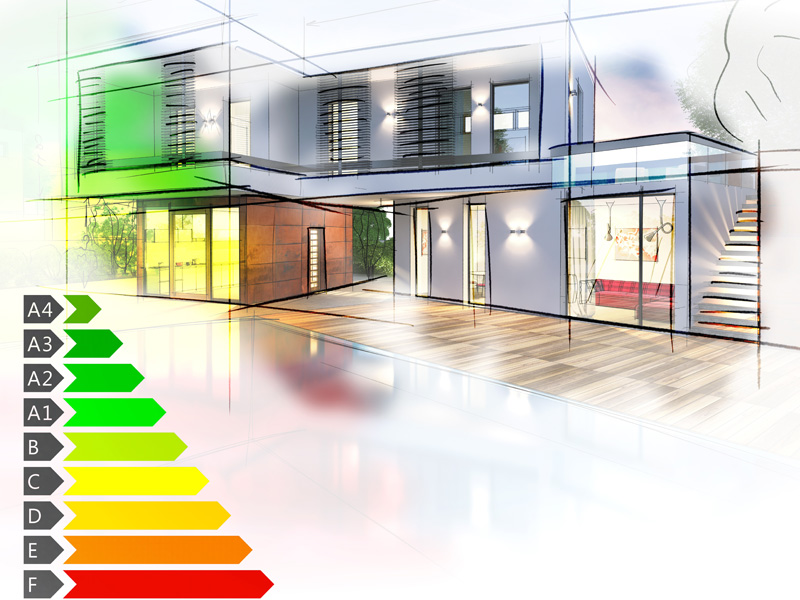
In construction company brochures, the energy class is typically presented as one more technical specification alongside the window frames and the insulation. In reality, it is purely an investment decision, one that determines whether the property you buy today will remain competitive in the market over the next fifteen years.
The picture becomes clearer once you look at the numbers and the timelines.
Where the Greek Market Stands Today
According to an analysis of 2,535,911 entries from the Energy Performance Certificate database (buildingcert.gr), only 17% of Greek homes in 2025 fall within the upper energy categories of A+, A, B+, and B. The overwhelming majority (55.23%) belong to the lower categories of E, Z, and H. Category H alone accounts for 34.13% of the housing stock.
The share of homes in the upper categories slipped slightly from 18.71% in 2024 to 17% in 2025. At the same time, the lower categories grew, as very old buildings continue to enter the certification process without any substantial upgrade.
Two realities follow this. First, a new A+ property belongs to a small fraction of the available domestic supply. Second, demand for modern, energy-efficient buildings meets a particularly limited market, a structural condition that supports their prices.
Upcoming European Legislation
The revised European Directive on the Energy Performance of Buildings (EPBD, EU Directive 2024/1275) entered into force in May 2024. Member states are required to incorporate it into their national legislation by 29 May 2026.
The key milestones set out in the directive:
- January 2028: All new public buildings must be Zero-Emission Buildings (ZEB). For new buildings larger than 1,000 m², the calculation and disclosure of the total life-cycle carbon footprint (GWP) become mandatory.
- January 2030: All new buildings across the European Union must be Zero-Emission Buildings.
- 2033-2035: A gradual tightening of renovation requirements for buildings in the lower energy categories.
At the same time, the new European Emissions Trading System (ETS2) begins in January 2028. Suppliers of fossil fuels used for heating will be subject to carbon levy, with the cost passed on to end consumers. From 2027, European subsidies for new fossil-fuel boilers are being phased out.
Under the new framework, the validity of Energy Performance Certificates for homes in the lower categories (D to G) is reduced from ten to five years, while for homes in the upper categories (A to C) it remains at ten. A lower-category property will require recertification every five years, with all the administrative and financial burden this entails.
How This Translates into Property Value
The market has already begun to factor these prospects in. According to the 2025 Spitogatos Insights analysis, in the Southern and Northern Suburbs of Attica, apartments in the upper energy categories sell for 52% more than those in the middle category, and at nearly double the price of low-efficiency properties.
In the Municipality of Athens, the average asking price for homes in the upper energy categories reaches 3,529 euros per square metre, 46% higher than the middle of the market and 84% higher than low-efficiency properties. In Thessaloniki, newly built apartments rent for 33.9% more than older constructions.
Behind this gap lies the market's awareness that a lower-category property will require costly upgrades in the coming years simply to remain legally compliant and commercially competitive.
What an A+ Building Actually Involves
For a building to be fully certified in category A+, a specific technical protocol must be applied jointly across every stage of construction:
- Full envelope insulation, with an external thermal façade system and 10-12 cm of insulation
- Energy-rated, high-airtightness window frames with triple glazing
- Elimination of thermal bridges across the roof, terrace, and floors
- Underfloor heating and high-efficiency heat pumps
- A solar water heater and the infrastructure provisions for photovoltaic systems
- Capability for mechanical ventilation with heat recovery
- Bioclimatic design that takes orientation and natural light into account
The energy class emerges from the overall behaviour of the building. Individual measures, however high in quality, are not enough on their own to achieve A+ certification.
Why Energy Class Matters Twice as Much in Epirus
In Ioannina, energy specifications carry an added significance. The Epirus climate combines cold, damp winters with hot summers. In a building that has not been properly designed, thermal bridges, inadequate insulation, and low-grade window frames quickly manifest as moisture, mould, and visible wear in the interior spaces.
At the same time, the rental market in Ioannina is sustained to a significant degree by students, medical staff, and international visitors. All of these groups are increasingly looking for energy-upgraded properties, as European energy awareness reaches everyday consumer choices.
For an investor or end buyer, an A+ energy class today amounts to one concrete guarantee: the property will meet the 2030 requirements without any further upgrade.
Book a Consultation
G&V Papathanasiou is the only construction company in Ioannina to deliver all of its projects fully certified at energy class A+. Across 25 years of operation, 30 completed buildings, and more than 400 satisfied buyers, energy protection has been applied as a consistent standard on every new project.
In a personal consultation, the company's team presents the full technical specifications of every available or under-construction property, explains the provisions of the upcoming European legislation, and answers your questions on the long-term performance of your investment.